Thursday, November 29, 2012

Progress

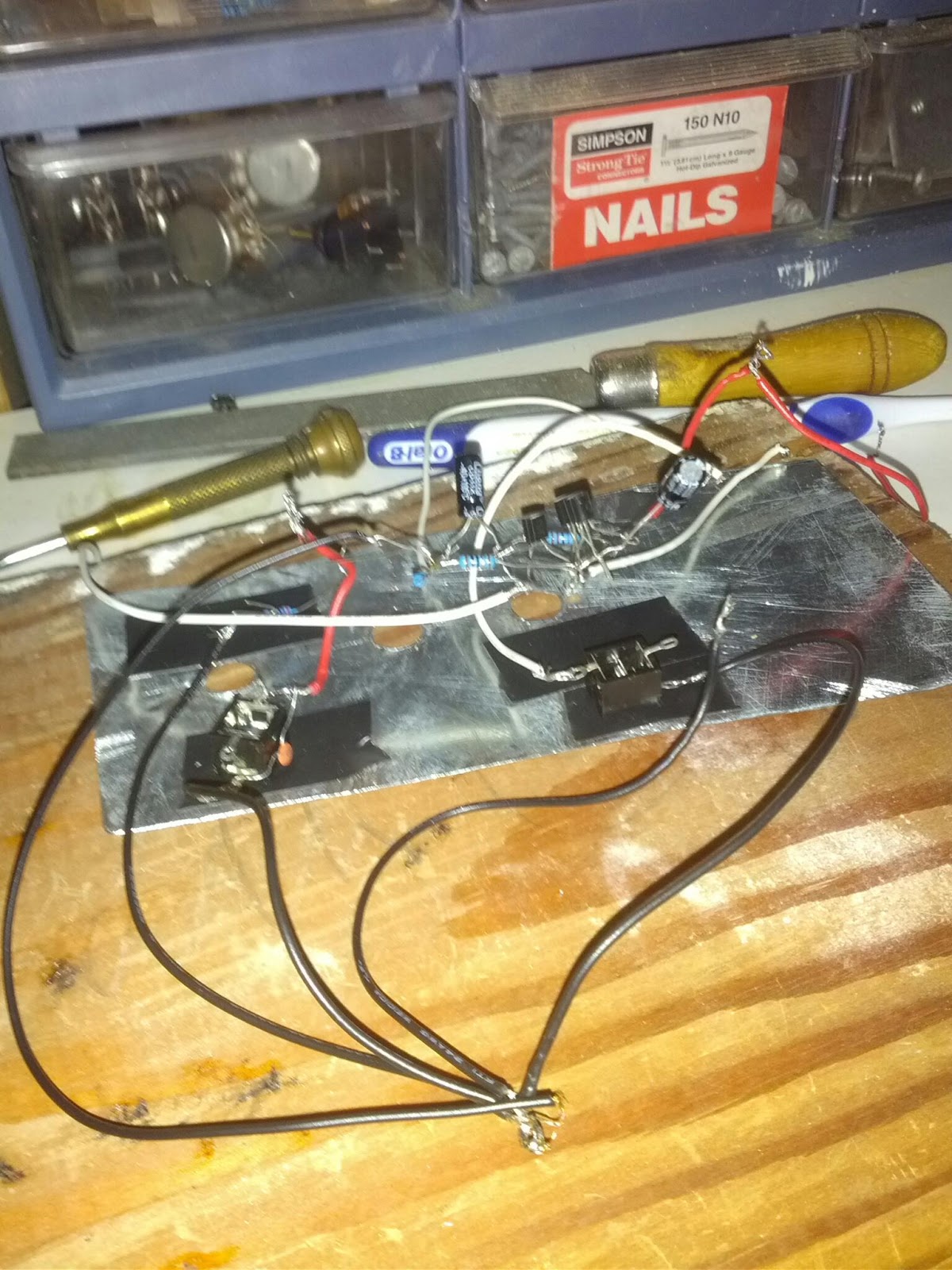
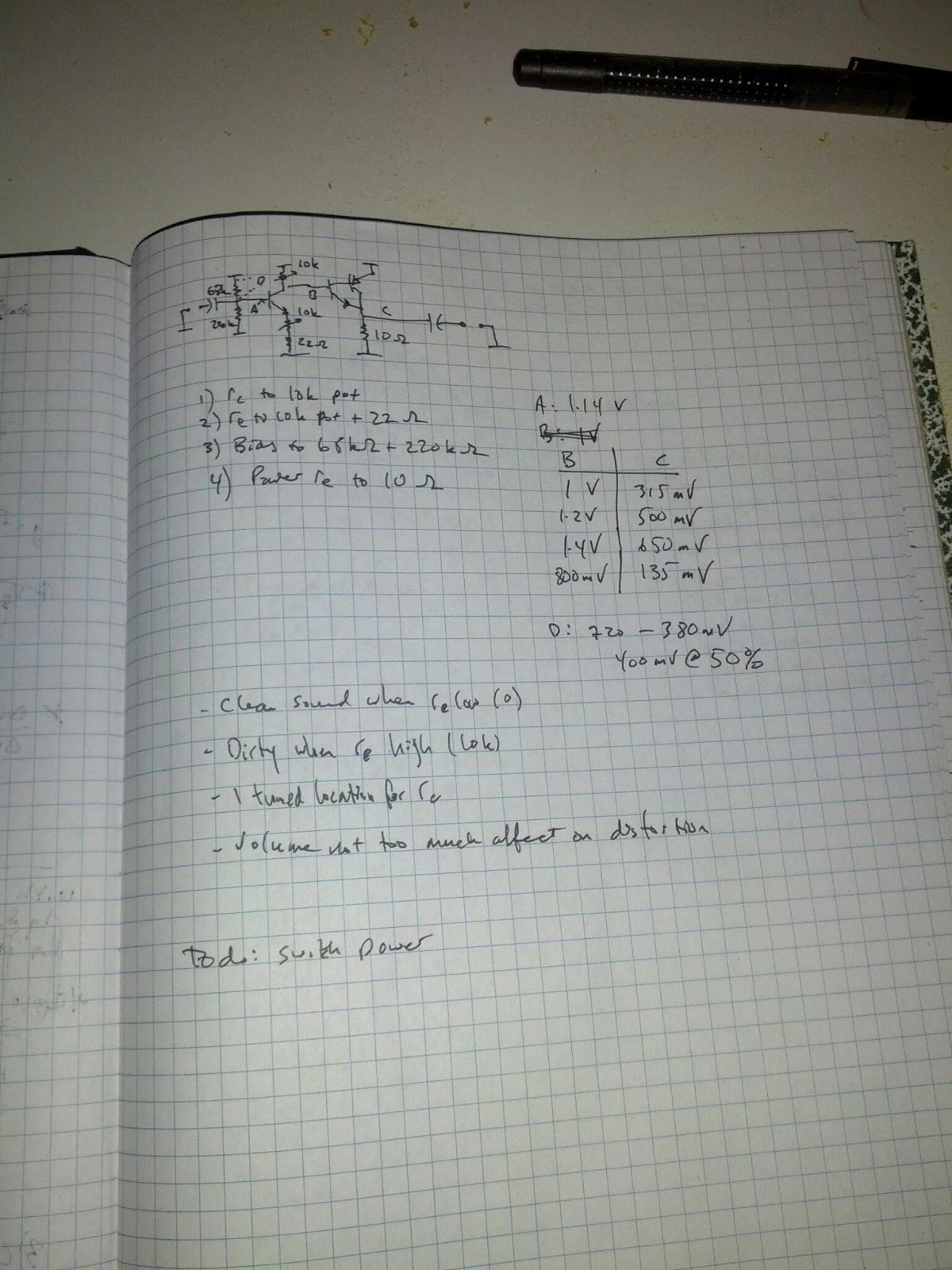
I've decided on the style of amp to use. With one cell of power, a small voltage amp stage followed by a Sziklai pair emitter follower seems to provide enough power to headphones. The voltage stage, with pots on both the collector and emitter, gives a nice range of clean to dirty sounds. You can see the rest setup below.

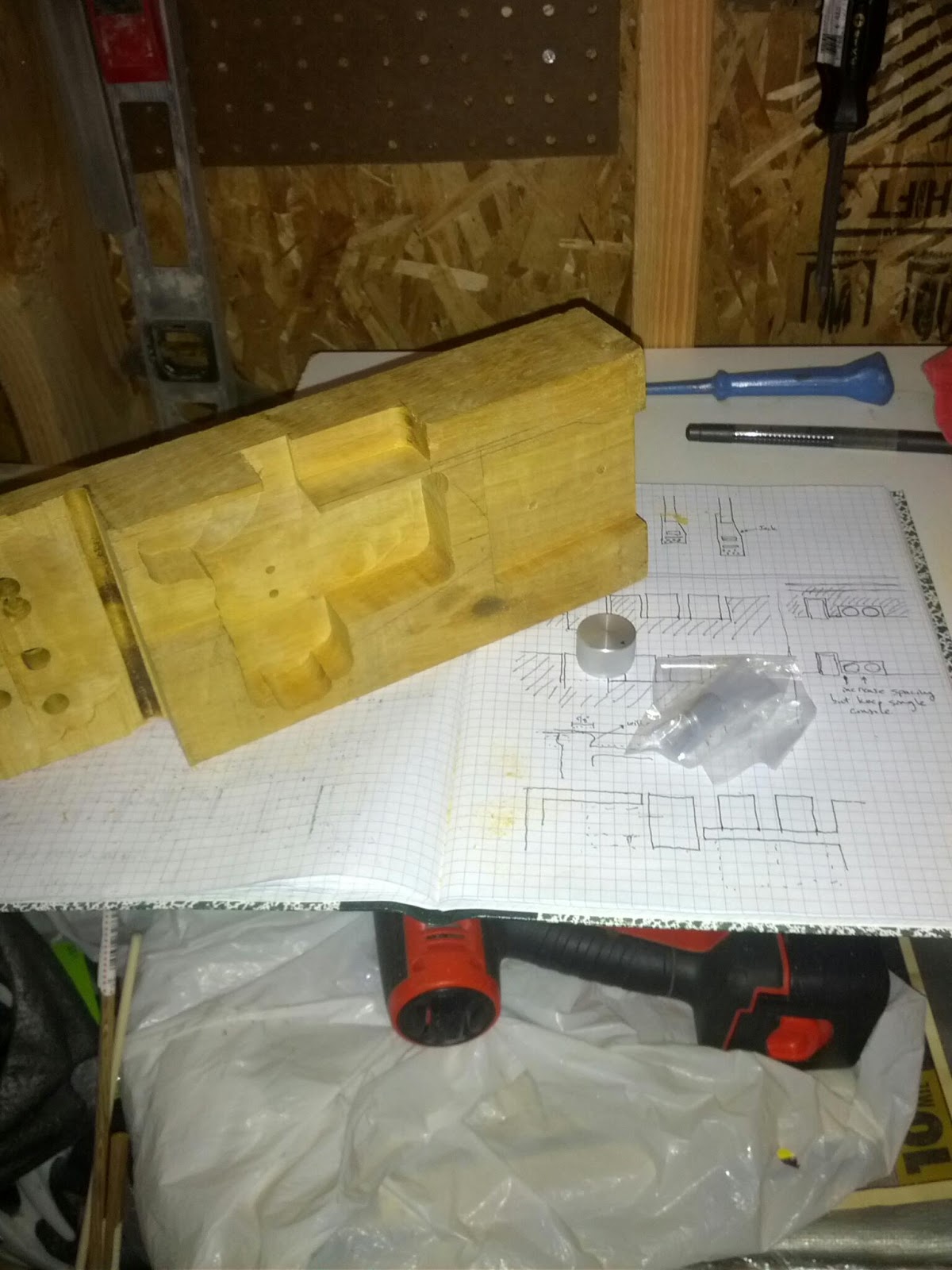
The adjustment process is a little weird. The collector register has to be tuned to the emitter degeneration in order to provide the right offset for the current output stage. Along with the volume control at the input, that makes for three knobs. I've sketched out an intriguing layout and am testing it with some scrap pictured here.
Monday, October 29, 2012

Revelations

I spent understanding now how high-impedance inputs can have noise problems, and how to reduce those by isolation. That didn't have any impact. I also looked closely at what I was setting my gain to (near unity), and realized that my estimates on the pickup voltage levels were way too low. So I think I don't actually need nearly as much gain as I thought I did. I tested this by just running the pickup through the output stage, and seemed to get good results. I'll run it through the four-track tonight so I can listen more carefully.

While this makes the final amp substantially simpler, it also excises my solution to the tone problem. Perhaps I'll have to stick a conventional second-order filter in.

Thursday, October 4, 2012

v1.2

I tried series feedback on the v1.1 model, and started picking up BBC World News without any other improvement. So maybe those spice model freakouts were accurate.

I thought a little bit more about a long-tailed differential pair, and decided I could use one after all. I had originally rejected it because one needs a current source and/or mirror for it to have good amplification. But I have plenty of gain due to my multiple stages, so don't need the LTP to have much umph. In addition, because the LTP has a non-inverting output, I can use just two following stages and so not increase my overall transistor count at all.

It did seem more convenient to use a virtual earth to offset the input and feedback. The spice modeling looks really good. Hopefully it will work in practice too.
I see that I mention a volume control, but didn't draw it in. I figure to place it at location C, so that I can turn down the volume and still keep distortion. That doesn't seem to work, though. It does reduce the amplitude, but introduces its own unique kinds of distortion. So maybe an in-line resistor in the headphone would work better, but according to spice that distorts as well.


Monday, October 1, 2012

Noise

This is without any negative feedback. Something is going wrong with the shunt feedback I initially tried, so I took it out for this recording.

Tuesday, September 25, 2012

V1.1 Actualized

Still need to add jacks and a volume pot. The power and ground buses are on the back side of the breadboard. Still figuring out layout; breadboards are a pain and I can see the appeal of designing a PCB.

Thursday, September 20, 2012

V1.1

My original idea of a Sziklai pair for the output buffer was good. My abort for the first version was based on a faulty understanding of when a BJT goes into saturation. I like the pair output buffer a lot better.

There's also an interesting effect when the input to the pair goes over 1.4V: the first transistor goes into saturation and starts pulling a lot of base current. In my configuration, this would pull down the last gain resister and so function as negative feedback. I wonder if this softens the clipping at all?

(Note there should a Miller capacitor in the last gain stage too.)

Tuesday, September 18, 2012

V1

I felt that the paired output buffer mentioned in the previous post wasn't a good idea, although this one, which seems more sensible, isn't achieving quite the same game; final output into 20Ω is barely a milliwatt. We'll see how it works... Happily enough, the performance didn't change between arbitrary resister values, and values that I have laying around the workbench. I think that's a good sign for my design.